

Materials, Mindfulness, Mastery:
Li Hongwei and the Art of Clay
Denise Patry Leidy
One of the most innovative and thoughtful ceramicists working today, Li Hongwei embodies longstanding Chinese perceptions regarding the role of art, and the nature of artistic practice. Calligraphers and painters, the most valued artists in Chinese history, were often extolled for their knowledge of earlier compositions and brush strokes. A meaningful work of art was expected to quote or emulate these styles, sometimes responding with original themes and new types of brushstrokes, but that was secondary to the display of historical knowledge. Brushing a painting or a calligraphy rooted in history, philosophy, and literature was viewed as a method of self-reflection, and development. Works of art lacking such underpinnings have traditionally (and not always accurately) been judged to be lesser creations. Although similar concepts are found in the West, usually again primarily associated with painting, these concepts appear much earlier in Chinese culture.
Li, who was introduced to painting and calligraphy in his home in Hebei Province, before studying at the Central Academy of Art in Beijing, follows this tradition using clay, particularly porcelain, to explore forms, ideas, and his place in the world around him while also celebrating China’s preeminence in global ceramic history. Works from his Weight of Meditation (fig. 1) series, among the first pieces he produced as a student at Alfred University, explore his identity, and the inherent challenges of a Chinese student in an American university while working with the American version of Japanese raku. The sculpture, crafted with a fired clay, prefigures many of the concerns that are highlighted in works produced throughout his career: an interest in scale, the layering and repurposing of shapes, and a fascination with surfaces. The latter is evident in the strips of clay that partially cover the faces in the work while hinting at the underlying substructure, enlivening the sculpture, and capturing a viewer’s attention.
Li’s ceramics often interpret earlier Chinese shapes, which have their own nuanced histories and symbolism. For example, a meiping or plum vase (fig. 2) echoes a vessel that first appeared in the Chinese repertory in the eleventh and twelfth centuries (fig. 3). Initially, known as a jingping or bottle with straight neck, by the seventeenth century, this shape was also used to display a blossoming plum branch, a harbinger of spring, and symbol of resilience. The meiping, which developed to store and serve distilled, as opposed to fermented, wine, evolved when the Chinese ceramic industry was flourishing, with thousands of kilns producing wares for the court, for domestic use, and for trade. Murals painted in tombs from this period (fig. 4), which often feature preparations for drinking wine and tea, attest to the popularity of these activities in many strata of society from the tenth to the thirteenth centuries.
The lush peacock blue crystals also derive from earlier Chinese traditions. The first use of crystalline glazes can be traced to kilns working in Fujian Province during the twelfth and thirteenth centuries when iron oxide in the glaze covering a tea bowl would precipitate to the surface to create astonishing patterns such as hare’s fur and oil spot (fig. 5). Tea bowls with such glazes, particularly those made in the Jian kilns, have played a fascinating role in global ceramic history. Some were traded to Japan: others brought there by Buddhist monks who traveled to China to study with famed monks. Five such Chinese tea bowls are designated as Japanese National Treasures, a testament to their historical and cultural importance. Moreover, tea bowls of this type made in both China and later Japan, and often designated by the Japanese word tenmoku, were introduced to the west in the late nineteenth and early twentieth century as part of the interest in Japanese ceramics that underlies the Arts and Crafts Movement (1880 – 1910). Appreciation for the work of potters, often inspired by East Asian ceramics, expanded in the West at that time.
The challenging crystalline glazes reappear in China in the late sixteenth and early seventeenth-centuries, a period of experimentation in the great complex at Jingdezhen in Jiangxi Province. By this time, Jingdezhen, nicknamed the “porcelain city,” had become the predominant center in China replacing most of the kilns active earlier in both the north and the south. Initially, the lush but delicate crystalline peach bloom glaze was reserved for a group of eight small items (fig. 6) used by scholar officials who ran the government bureaucracy, many of whom were also famed calligraphers and painters. Peach bloom, and other seventeenth and eighteenth century high-fired glazes, such as oxblood (sang-de-boeuf) or moonlight (clare de lune), become known in Europe after the seventeenth-century due to the overwhelming extent of global trade in Chinese porcelain at the time. By the late nineteenth century, ceramicists such as French Taxile Doat (1851 – 1939) were experimenting with high-fired or grand feu ceramics creating variants of these extraordinary glazes including works with crystals patterns. (fig. 7). It is interesting to note the Doat was one of three ceramicists hired in 1909 by the Art Academy and Porcelain Works in Missouri to help spur the American ceramic industry, a decade after the English-born Charles Fergus Binns )1857 – 1934) became the founding director of Alfred University, established for the same purpose. Although crystalline glazes were popular in western ceramics in the late nineteenth and early twentieth century, they disappeared after World War I, possibly due to the costs and the difficulty in making them, but became popular again in the late twentieth and early twenty-first century.
Like the peacock blue on the meiping discussed above, the lush but delicate crystalline green forms (fig. 7) on Upwelling of Gravity # 3 (fig. 8) appear to exist beyond the surface of the clay, adding movement and vitality to the sculpture. The Chinese language title (li) for works in this series translates as high mountains, but is also a homonym for strength, and power. In English, “upwelling of gravity” refers to an event when colder, denser water rises to the surface of a body of water, and apt metaphor for the process and effect of Li’s unique glazes. While the upper part of Upwelling of Gravity is crafted with porcelain -- a Chinese invention from the seventh century -- the lower section of this tear-or-rain-drop shaped sculpture is made with stainless steel -– a hallmark of the industrial revolution invented in the early nineteenth century. Stainless steel shares the reflective nature of a glaze but allows a viewer to see himself/herself in this work of art adding visual depth, and an interactive element, to Li’s work.
Li Hongwei began to experiment with stainless steel in 2009 and successfully incorporated it into his work in 2014. Xuan # 30 (fig. 9), which also takes the form of a liquid drop, and is covered with his characteristic green “traces of ink” glaze (an echo of the shades of green favored in the Chinese celadons of the tenth to the fourteenth century), further attest to his astonishing melding of these two distinct materials. Xuan, the Chinese character for the title of the works in this series can be traced to the Daodejing (or Tao Te Ching, “The Way and Its Power”), the seminal text for the practice of Daoism. Daoism, which derives from the character dao meaning way or path is a term for longstanding beliefs and practices, which coalesced during the second and fourth century, and include metaphysical and philosophical speculations, the ability to become a fully realized individual or a sage, and mundane benefits such as wealth and fame. In the Daodejing, the character xuan means mysterious, and implies the exploration of mystery. The Chinese language lends itself to homonyms and puns: another character that is also pronounced xuan connotes hanging and suspension, an accurate description of the use of a thin wire to suspend and display this, and other works, in the series. Homonyms are often found in the decoration of Chinese porcelains after the seventeenth century. For example, the popular theme of flying bats is an allusion to and a wish for wealth. The characters for both words are pronounced fu.
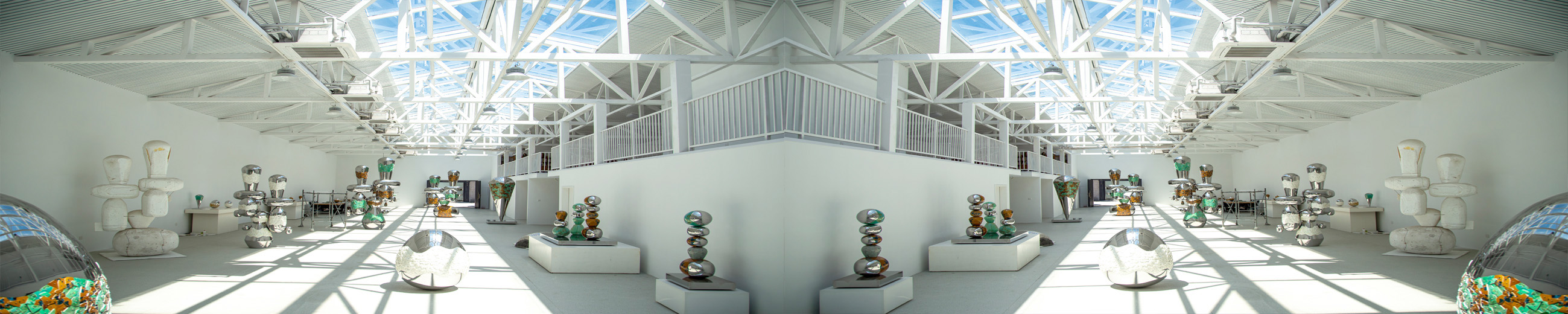
The delightful drop shapes found in both Upwelling of Gravity and Xuan, as well as the distinctive gold and blue, and green glazes, are also featured in Allegory of Balance #41 (fig. 10). In this series, Li reinterprets and refocuses his visual language melding beautifully crafted and glazed porcelain shapes with other equally well-made pieces in stainless steel. Li and his assistants make each element individually before carefully assembling the finished work: the steel elements are usually fitted to the porcelain pieces. Allegory of Balance further illustrates Li’s study of the Daodejing and other philosophical treatises. This sculpture combines shapes, materials, and surfaces, a melding of elements that alludes to the Daoist concept of yin and yang. Yin associated with the female, earth, the moon, and darkness, and yang symbolic of the male, the heavens, the sun, and light, are in a constant state of transformation and balance. The unexpected juxtapositions of shapes and patterns to create Allegory of Balance beautifully illustrate the yin-yang symbiosis, which is at the heart of the cosmos, and the basis of our daily lives.
Balance, transformation, and interconnectivity also inform the seemingly precarious sculptures in the Dan series. Dan # 12 (fig. 11) is crafted with a green-glazed porcelain in the center, and two stainless steels caps, perfectly melded to fit the shape of the porcelain center, at the ends. The darker organic green crystals, suggestive of gingko leaves or some other foliage, which precipitate from the light blue-green glaze, appear to be suspended from the narrow stems that fall from the edges of the steel cap at the upper edge of the piece. The Daodejing, which speaks of something undefined coming into existence before Heaven and Earth, once again informs pieces in this series. Moreover, the title dan refers to the Chinese character for egg, as well as those for birth and dawn, which are pronounced the same way. All three words, in both Chinese and English, allude to new beginnings of the cosmos, days, and individuals.
Another tilted egg-shaped piece The Origins #7 (fig. 12) has a center sculpted with broken fragments of glazed porcelain that are held together with stainless steel screws attached to underlying sheets of stainless steel. Potters have discarded imperfectly shaped or fired pieces for millennia. As ceramic became more important and valued everywhere, partially in response to widespread use of Chinese porcelain, however, broken pieces were more likely to be conserved. This is particularly true in Japan where, beginning in the sixteenth century, gold lacquer (known as kitsugi) was used to repair and preserve cherished ceramics, often works imported from China that were particularly treasured. Li, who also initially discarded damaged or less-than-perfect pieces, chooses to give these bits new life by incorporating them into his work. The porcelain bits at the heart of The Origins illustrate an interest in layering long highlighted in Li’s work: it can be seen in the crystalline patterns that dance in the glazes, the combining of materials, and the juxtaposition of disparate forms. During an interview at the Kalamazoo Institute of Art in 2022, Li explained that he started working with these fragments as a response to his growing awareness of the conflicts in the United States as he travelled throughout the country just before the pandemic in 2019. He reunites these bits, symbolic of destruction, damage, and brokenness to make masterful pieces that serve as signposts and advocates for creativity, balance, and harmony much needed in the world today.
Denise Patry Leidy currently serves as the Ruth and Bruce Dayton Curator of Asian Art at the Yale University Art Gallery. Prior to joining Yale, Dr. Leidy also served as the Brooke Russell Astor Curator of Chinese Art (emerita) at the Metropolitan Museum of Art, as well as in curatorial positions at The Asia Society New York, and the Museum of Fine Arts, Boston. She is endlessly fascinated by the development and movement of technologies, ideas, and images within and between Asian cultures, and between these centers and those in Africa, Europe and the Americas. In addition to curating exhibitions, she has published and lectured widely exploring topics in Buddhist art, Chinese and other Asian ceramics, and East Asian lacquer. Her publications include Buddhist Art: Its History and Meaning, Mother-of-Pearl: A Tradition in Asian Lacquer, Wisdom Embodied: Chinese Buddhist and Daoist Sculpture in the Metropolitan Museum of Art, How to Read Chinese Ceramics, and the recently released Celadon on the Seas: Chinese Ceramics, 9th - 14th century.


