

Looking Back: A Window on the Present
Wayne Higby
To say that the theme of “duality” is at the core of Li Hongwei’s breathtaking sculptures is, at best, a serious understatement. Here is only a partial list of some of the binary oppositions at play in his work: Old vs new, East vs West, hand-made vs industrial, delicate vs strong, yin vs yang, functional vessel vs non-functional sculpture, lightness vs weight, organic vs geometric, literal vs metaphorical, complexity vs simplicity, the real vs the reflection, heaven vs earth, colorful vs colorless, material vs conceptual, intention vs chance, creation vs destruction, the perfect vs the failure, the fragment vs the whole… the reader is encouraged to add to this list at will.
Constructing Radiance: Sculpture by Li Hongwei was chosen as an exhibition title early on in the development of the Alfred Ceramic Art Museum’s presentation of Li Hongwei’s art. I wrote a short piece of wall text to illuminate the title:
Sculpture, a product of constructing forms in three-dimensional space, is embedded in the history of human endeavor and is often associated with a search for meaning. Radiance is an ephemeral condition, a reflection of light or a rare luminosity. Radiance often suggests an exquisite harmony as universals underlying reality unite in timeless balance. These words which contextualize the current exhibition suggest a framework for contemplating the ever-expanding achievement of sculptor Li Hongwei.
Li was born in Tangshan, China. As a youth he exhibited interests in calligraphy, painting, mathematics and athletics. Li passed the highly competitive entrance exam for admission to the prestigious Central Academy of Fine Arts, Beijing. There he received formal training in sculpture graduating with a BFA in 2005.
That year I became a witness to Li Hongwei’s remarkable journey as an artist. Anticipating his graduation from the Central Academy of Fine Arts, Li applied to be a candidate for the Master of Fine Arts degree in ceramic art at the New York State College of Ceramics, School of Art and Design at Alfred University, Alfred, NY. As a professor of ceramic art I was on the committee that chose eight candidates for the degree from approximately 100 applicants. Li was one of the eight who arrived at Alfred in the fall of 2005. By then I had already met him.
Earlier that summer I was doing a workshop in Beijing at the Central Academy of Fine Arts. On Monday May 23, 2005, Li Hongwei came to the workshop and introduced himself to me “I am coming to Alfred,” he said. I responded. “Yes, I know.” He wrote his name in English and Chinese in my journal and left his phone number. On Friday May 27 we had dinner together. That was the beginning of a long and extraordinary professional relationship.
The following is an excerpt from: Cultivating Dualities: A Conversation with Li Hongwei which was a question-and-answer session facilitated by Michael Amy for Sculpture Magazine, 5/22/2019.
Li Hongwei: “The Department of Sculpture at the Central Academy of Fine Arts (CAFA) in Beijing has a "five-year program that borrows its educational approach from the École des Beaux-Arts in Paris and the Repin Institute of Arts in St. Petersburg. Students in the sculpture department were trained to create realistic renderings of the human body. Our styles back then were inspired by the works of Michelangelo, Carpeaux, and Rodin. During my five years at CAFA, I worked hard to improve my technical skills and my understanding of space. I have come to appreciate the rigorous training that I received there. I also looked at other approaches and produced some abstract sculpture during those years, working with steel, bronze, and different types of clay.”
Li Hongwei includes the following comment in his conversation with Michael Amy: “For me, clay has a special power in the way that it takes on shape and changes. It is capable of seizing my emotions, movements, and memories. Back then, I could not feel anything close to a comparable connection with other materials, and I spent my last two years at CAFA experimenting with fired clay. I love the feeling of clay—this is why I went on to study at Alfred.” 1.
In contrast to Li Hongwei’s undergraduate background, the pedagogical approach regarding the MFA program in ceramic art at Alfred University begins with the assumption of a fundamental ceramic material and process skillset as a baseline determined via the application process. The primary emphasis of the program is based on expanding those skills with a focus on the individual artist as maker. Following, informing and supporting the individual artist’s intuition and initiative is a primary goal of the program. The study of art history, particularly ceramic art history across a wide spectrum as well as ceramic materials course work, seminars and highly intensive studio work are required within the frame of faculty-student interactions.
At Alfred, in the fall 2005, I was assigned to be Li Hongwei’s graduate advisor and to work with him through-out his first semester. He had been drawing some self-portraits in his sketch book. So that was a place to begin. As it worked out, I was also his advisor for his final thesis semester. Later I wrote an essay Self-Portrait: The Art of Li Hongwei for the first book on his work, Beyond Reflection: The Art of Li Hongwei published by Pucker Art Publications in 2018. That text began with the following paragraph.
“Li Hongwei is among the new generation of artists who have taken a deeply rooted, Chinese national identity and revolutionized it via individual perspectives. His achievement in ceramic art is especially significant. Li Hongwei's acceptance into the renowned Master of Fine Arts program in ceramic art at Alfred University marked a significant step in his development as an artist and a significant step in the arc of his life. For Li Hongwei, studying in America brought his personal life story into deep scrutiny. The cultural diversity between China and America offered a comparative analysis that focused the challenging question: Who am I? In an attempt to answer that question, the artist began a series of self-portraits in fired clay.” 2.
Li’s cross-cultural educational experience established a foundation for his art as he fused both classic Chinese cultural history with attention to Western philosophical discourse established in the history of Modernism and contemporary art. Li’s combination of East and West cultural immersion along with a sophisticated investigation into ceramic technique has led to his international recognition as an important sculptor of our time.
Li graduated in 2007 and remained in Alfred teaching freshman in the foundations program of the Art and Design School. In the spring of 2008 he called me and asked if we could have a conversation. During that conversation he said that he planned to return to China and we began to brainstorm what he might do there to earn a living.
In 2008, I was in the process of working on an architectural project now entitled EarthCloud commissioned by Alfred University alumnus Marlin Miller for a performing arts complex he was building for the University. At that time, Miller offered me an additional architectural commission for a theater that he was also building in Reading, Pennsylvania. I began to consider the Reading project as something I could facilitate in collaboration with a factory in China. But how?
W. Higby China Journal entry 6/4/2008: Individuality Art Ceramics factory, Foshan China.
Li Hongwei is here. Hongwei just graduated from Alfred with his MFA. He is one of the important reasons to try to do this project now. The plan is for him to move to Foshan, get a studio, a place to live and oversee the project at the factory until it is finished.
Foshan, translated as “Buddha’s Mountain,” is one of the largest ceramic tile production centers in the world. Li Hongwei lived in Foshan for a year from the summer of 2008 to fall of 2009. He was able to establish a studio for his own work at the Nanfeng Ancient Kiln cultural site in Foshan. Li produced a new series of self portrait heads based on a monumental piece
he made for his graduate thesis exhibition. (fig 1+2)---- caption: Hongwei, first studio post grad school, Foshan, China 2. caption: Hongwei- at the Guanyin on Mount Xiqiao, Foshan, China
During this period I made 5 trips to the factory and at other times consulted directly with Li by email and phone from my Alfred studio. From the onset of the project Li
demonstrated a charismatic way of translating my vision as he explained the details of my thinking on how together we could make something beyond our previous experience. His exceptional bilingual skill at the factory helped immeasurably from the first day to create an atmosphere of friendship and commitment to an unknown artist from America. Perhaps growing up in Tangshan, a major industrial city referred to as the "porcelain capital of North China," gave Li a special intuitive insight into the soul of a mega factory city and its hard-working population.
(fig 3)----caption: First day at the factory with Li Hongwei, Foshan. China
This introduction to the artist Li Hongwei and his exhibition at the Alfred Ceramic Art Museum is intended as a biographical sketch of the artist which attempts to offer insight as to the background story behind the art itself. As such it is interesting to note that not only is Tangshan, China, the northern capital of porcelain manufacture, it is also the world’s largest steel producing center. It would be misguided to draw any direct relationship between Li’s art in steel and porcelain. However, early years immersed in the life of an industrial city empowered by a work force of makers might lead to a subconscious acquisition of knowledge and to the eventual discovery that tireless work with ancient and modern materials would be for Li his characteristic signature as an artist. This lends a bit of ethos to the discourse about Li Hongwei’s art which includes speculation on the cultural differences of East and West as well as the history of media.
With Li’s continued help, the Reading project, renamed SkyWell Falls, was installed at the Miller Center for the Arts, Reading, Pennsylvania in the fall of 2009. Once the installation was completed Hongwei returned to China.
W. Higby China Journal entry 6/4/2010: Tangshan, China.
Long awaited trip to Tangshan to visit Li Hongwei’s home town. We have often talked about a trip to Tangshan which is about 2 1/2 hours NE of Beijing.
Li Hongwei and I spent the day touring Tangshan which included lunch with his parents and a visit to their home where Li grew up. One particular topic on that day of reminiscing about Li’s youth included a conversation about drawing. The following is a quote from Li Hongwei’s graduate MFA Thesis Report required as part of the thesis exhibition held at the conclusion of the two years of graduate study.
“When I was a child, I liked drawing architectural designs, but mostly, I drew our house over and over. When I moved later to go to school in Beijing and now in Alfred, I always keep the memory of the physical places where I lived foremost in my memory - places that signify home, safety, warmth. I've never stopped drawing the places where I live, each one different in its own way.” 3.
Li Hongwei’s propensity for drawing took on increased dimension as a student at the Central Academy of Fine Arts where observational drawing serves as a fundamental exercise in skill development. The ability to concentrate and render objectively the human figure or still life requires a discipline seldom acquired by contemporary American art school students. Drawing is the most direct, immediate access to the artist’s eye, hand and mind. Often it signals an emotional intelligence as well as a tracking of the interface between an artist thinking and the world at large. It can serve as a planning device, a first stage problem solver or a record of a feeling in pictorial form. Li’s foundation as a disciplined observer was there since childhood and grew exponentially as a mature artist. Today we see this in the intense attention to detail incorporated into each element of his sculpture. The fluidity imbedded in the interchange of parts to the whole as well as the unity and balance that give the work its powerful presence is at its core a possibility of imagination tied to a life of observation and drawing as exploration. (fig.4) ---caption: Drawing for
Numerous trips in China with Li Hongwei included visits to five different studios as his career began to develop. As I have mentioned, his first studio was in Foshan during the making of SkyWell Falls. His second studio was a small one as might be expected in Beijing, but the work continued to reveal an intensity that was a clear signal of exceptional things to come. What I noticed for the most part was a battery of glaze tests and materials, a potter’s wheel and a rather small electric kiln. Hongwei was working on his investigation of crystallin glaze begun in graduate school. Step by step this investigation and the form and surface integration he sought became abundantly clear. Honoring the rich history of pottery form and glaze achievements of ancient China he perfected a language of reflection on the luxurious vessel. His distinctive eye and disciplined enjoyment of a skilled exploration of form in space produced the definitive pot as a celebration that introduces his exhibition at the Alfred Ceramic Art Museum. This work is a leading contemporary reflection on classic pottery as an artform. This is not mimicry. Far from imitation, these pots are fresh, exquisite statements of a maker’s art. The word mimicry suggests to me an academic-studied efficiency. Li’s pots are masterfully attentive to the sensuality of his materials. With a quality of ease and abundance his vessels echo a history of opulence as they blend surface and form into a resonate state of wonder. (fig.5)—caption: Li Hongwei, Olive
Vase 2017, porcelain, 8 x 8 x17 inches. Photo by Brian Oglesbee
Subsequent studios in West Beijing were larger. I visited a studio in West Beijing from which we traveled into the mountains referred to as the Fragrant Hills. In this studio I notice for the first-time thousands of ceramic shards. Realizing that the crystallin glaze investigations produced many unsuccessful results, at first the shards seemed simply fundamental to a ceramic artist’s process of critique. However, Li was recycling these shards into new works of sculpture.
What I saw in Li Hongwei’s studio that day was a pragmatic caring and concern for inevitable waste associated with the ceramic process. This concern led to a possibility befitting the moment. However, I hesitated to assume that the reason behind this move toward sculpture was to intentionally establish an analogy to the chaos and detritus of the contemporary world or the purposeful demolition of the past. Thinking of the awareness and concern for process and waste encourages the thought that there is an overlapping of pragmatic intention and a deep intuitive sensitivity to the artist’s time in history. Li Hongwei speaks of freedom. I think of the artist’s need to free oneself from past work, to move to new challenges, to find what is next. An artist’s aspirations and the potential of analogies may certainly coincide. The demolition of the past has more than one interpretation. Artists proceed to embrace making by following the process and the materials as they lead the way to a reflection on results. There is then a pause during which a recognition of conceptual complexities may arise. Next there is a move forward with renewed awareness and purpose. This activity is the raison d'être of being alive for the artist. (fig 6) ---caption: Li Hongwei, 2022, making porcelain shards
The analytical discourse of artistic intention may arise from answering the question: Why this art now? This question is a consideration of a sociological frame of reference. All artists are immersed in their time. The “reveal” associated with the art, consciously intended or not, gives the art its significance. The audience attentive to work in its time may give art a particular reading—an understood meaning befitting presumption. However, art does not only stay embraced by its time in history. It may escape to become meaningful over and over again as it floats in the either of human experience.
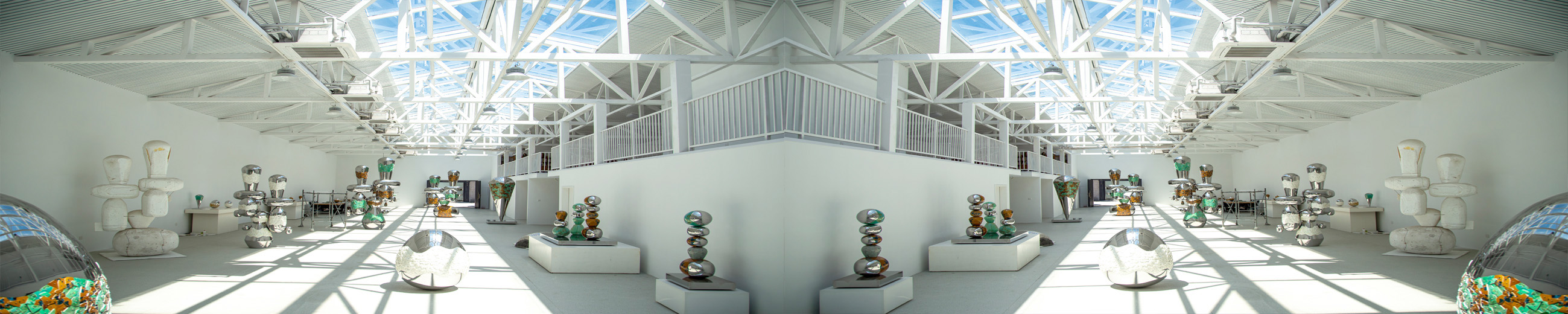
As Hongwei began to be recognized, the demand for more work space became important. His new Beijing studio, under construction when I visited there in December 2023, is magnificent. It is an immense space with white walls and massive sky light windows. (fig 7) ------- Li Hongwei’s current studio in Beijing, 2023
In 2012 Li Hongwei returned to Alfred to help finalize the installation of the second phase of EarthCloud. I had gathered a team of assistants, all Alfred ceramic art graduates, to complete the installation. Our start date was May 1, 2012. We had meetings each morning to set the day’s schedule and several weeks of progress took place. Then, at one of our morning meetings, Li began the day by inviting us all to his wedding at Foster Lake, a beautiful local recreational site under the care of Alfred University. The wedding took place on the 7th day of the 7th month. It was July 2012, the year of the dragon. The dragon in Chinese lore is a powerful symbol of good fortune. The dragon is the water god -- the god of clouds, thunder and rain. The dragon dwells in pools and lakes from which the dragon rises into the clouds. The dragon is of the earth and the sky.
Li Hongwei and his wife Luqing have three wonderful children. They divide their time between living in Beijing and Alfred. The cross-cultural continuum begun in 2005 by Hongwei has become a precious gift leading into the future.
Because of the exhibition here at the Alfred Ceramic Art Museum, I have had the rare opportunity to spend time with Li Hongwei’s art during multiple viewings. Via its outward sign Li’s art proposes a place where the finite and infinite intersect. Li’s sculpture simplified in the Upwelling Gravity series (fig. 7) brings me to a threshold where imagination breaks the bonds of gravity. My bodily sensation brings to mind reflections on the athleticism of ballet and the late 18th century invention of the pointe shoe, devised to create the illusion that the dancers were weightless. Once while in the Museum gallery experiencing Li’s sculpture, I thought about Georgian-American ballet choreographer George Balanchine’s brilliant choreographic formalism which often incorporates the tradition of the pointe shoe. Balanchine's style has often been described as neoclassic. I began thinking that Li has established a reimagined variation of neoclassicism comprised of his personal sense of Western tradition, Chinese philosophy and modernist abstraction. This particular alchemy consists of combining formality and order with seductive materials and technical prowess to achieve a unifying, optimistic balance of dynamic contrasts. The absolute is presented, yet only momentarily. Analogous to ballet, body movement in space allows new perspectives to continually emerge as I move around the sculpture. I see myself reflected in the work and feel myself in a vortex of vision and revision where the world of extraordinary material fact is dramatically present as an invitation to a sensual and cognitive journey beyond anything previously imagined. caption: (fig 8)—Li Hongwei Upwelling of Gravity #52, 2019, porcelain, stainless steel, 9.8 x 9.8 x 21.7 inches. Photo by Brian Oglesbee
Works of art lead toward contemplation. Consideration of the binding relationship between material, process and artistic purpose is necessary to grasp the bounty art offers. Li Hongwei’s command of his personal vision is a major testament to a transformation of material and process into sculptural luminescence - a distinctive dimensional poetry of Radiance.
Wayne Higby is a Professor of Ceramic Art and the Wayne Higby Director and Principal Curator of the Alfred Ceramic Art Museum at Alfred University. His ceramic art works are held in the permanent collections of numerous art museums around the world including the Metropolitan Museum of Art, New York, the Smithsonian American Art Museum, Washington, DC, the National Art Museum of China, Beijing, the Hermitage Art Museum, St Petersburg, Russia, and the Museum of Modern Art, Tokyo. Higby's retrospective was held at the Smithsonian American Art Museum and documented in the book Infinite Place: The Ceramic Art of Wayne Higby published by Arnoldsche in 2013.
Footnotes:
1. Cultivating Dualities: A Conversation with Li Hongwei, Michael Amy, Sculpture Magazine, International Sculpture Center, Hampton, NJ, 5/22/2019.
2. Self-Portrait: The Art of Li Hongwei ,Wayne Higby, Beyond Reflection: The Art of Li Hongwei, Pucker Art Publications, Boston, MA ISBN 978-1-879985-37-7, 2018.
3. Steering My Ship, Hongwei Li, Master of Fine Arts Thesis Report, Scholes Library Archives, Alfred University, Alfred, NY, 2007.


